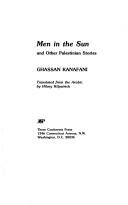
Born in Acre in 1936, Kanafani fled with his family to Lebanon and then to Damascus during the 1948 Nakba. He worked as a journalist across the Arab world, edited the Popular Front for the Liberation of Palestine's newspaper al-Hadaf, and produced — in a career cut short at thirty-six — a body of fiction that made the Palestinian experience legible in Arabic for the first time as something other than political slogan.
His novella Rijal fi al-Shams (Men in the Sun, 1963) follows three Palestinian refugees being smuggled across the desert to Kuwait inside the empty water tank of a lorry. The ending — they suffocate at the border while the driver argues with a Kuwaiti official — is one of the most-quoted closings in Arabic fiction. The follow-up novella Ma Tabaqqa Lakum (All That's Left to You, 1966) experimented with multiple narrators and a fractured time-scheme that anticipated almost everything later Arabic novelists would do with form.
‘A'id ila Hayfa (Returning to Haifa, 1969) is perhaps his most-discussed work: a Palestinian couple, after the 1967 war suddenly opens the border, returns to their old house in Haifa and meets the Jewish family that has lived in it — and raised the infant son they were forced to leave behind in 1948. The novella refuses the easy consolations of either side and remains a touchstone of Palestinian-Israeli literary debate.
Kanafani was killed in Beirut in July 1972 by a car bomb planted by Israeli intelligence; his seventeen-year-old niece Lamees, in the car with him, was killed too. He had also been a critic and theorist; his 1968 study Adab al-Muqawama fi Filastin al-Muhtalla (Resistance Literature in Occupied Palestine) named the genre that would dominate Palestinian writing for decades.
Recurring themes
Selected works
- 1961Death of Bed Number 12
- 1963Men in the Sun
- 1966All That's Left to You
- 1969Umm Saad
- 1969Returning to Haifa
- 1962The Land of Sad Oranges